
The story was simple: make Abbott and Costello’s “Who’s on First?” something you can see. A web page that plays the routine and lights up each player the moment he’s called, so you can watch the joke jump from base to base. It’s set like a 1930s radio bill, with baseball cards thrown in for fun, and it’s quick to take in.
Proof of conceptInteractive storytelling2026
What’s your story? Who’s on first?
Project film · 0:30
The story
What was the story?
Make a joke you’ve only ever heard into something you can see.
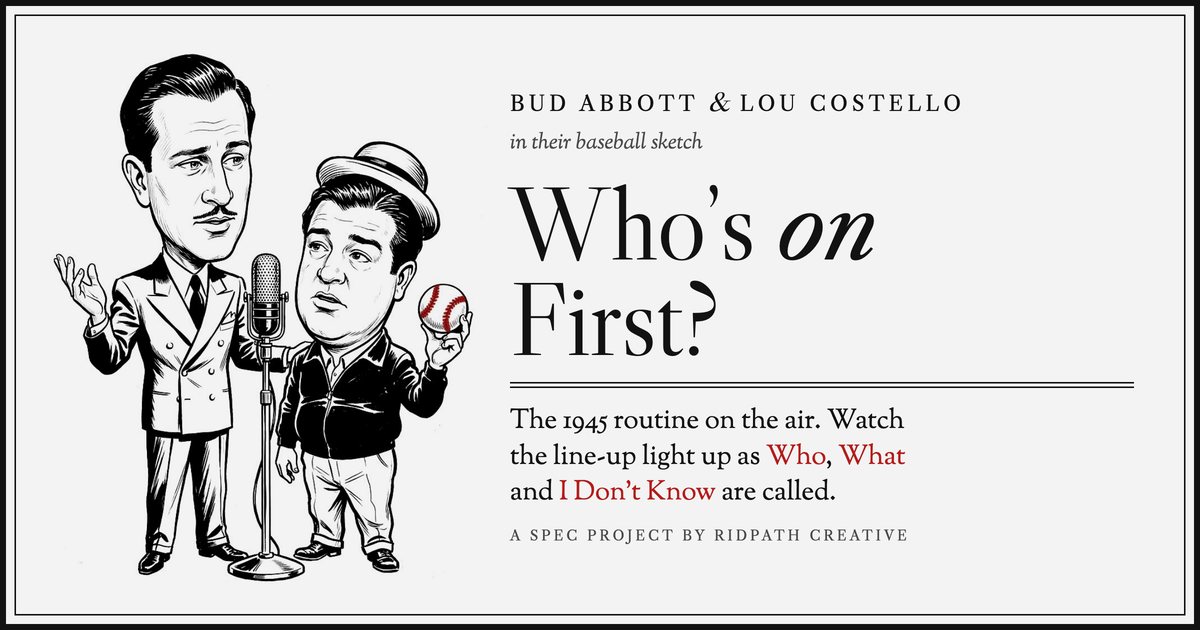
“Who’s on First?” is really a map: Who on first, What on second, I Don’t Know on third. You can hear it. I wanted you to watch it, on one page that plays the routine and shows the players as they’re called, so it’s clear how the joke jumps around the diamond. And it had to be easy to follow, even for someone who’s never heard it.
The field
How does the page show who’s being called?
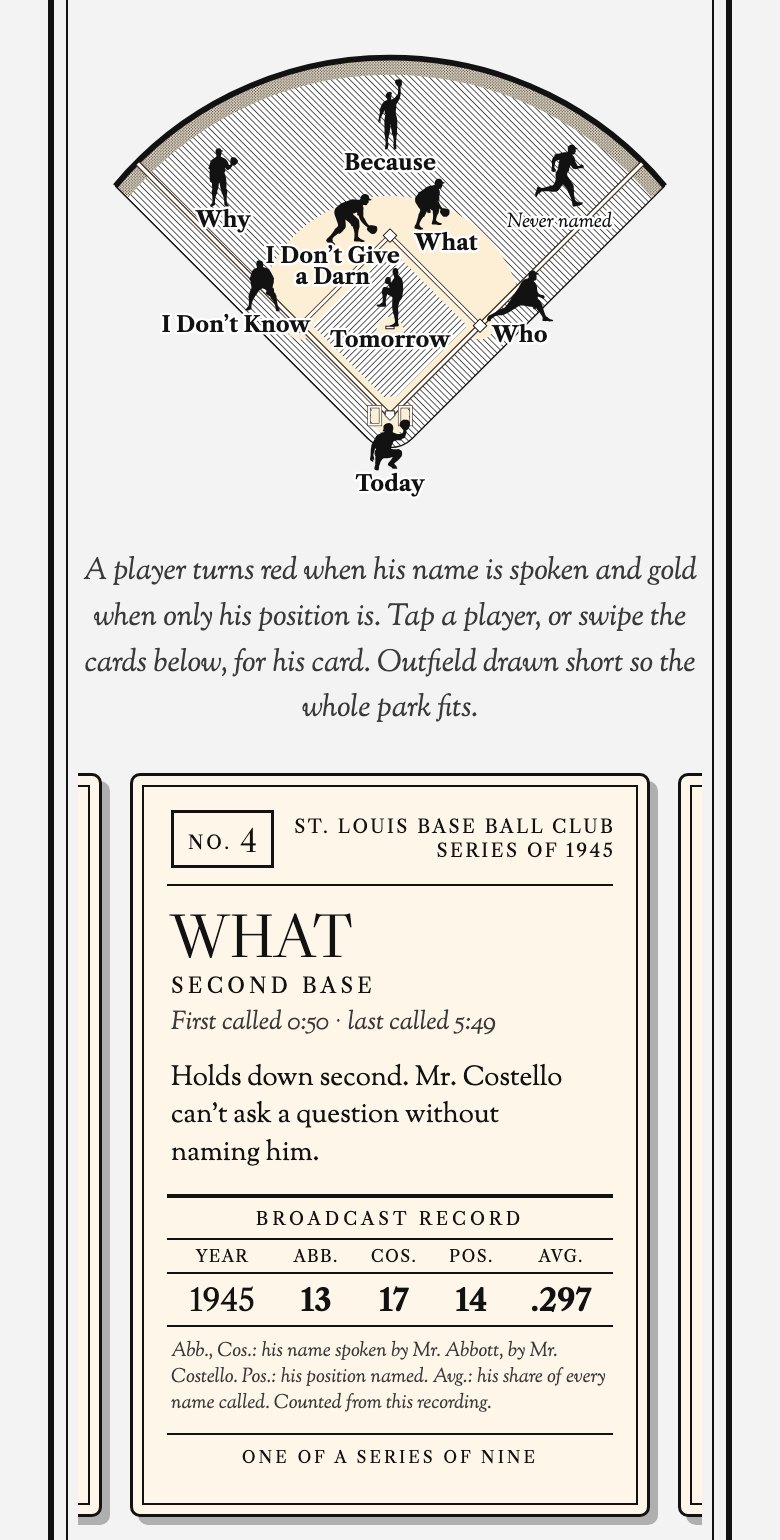
Every name and position lights up the moment it’s spoken, 182 of them.
When Abbott says “Who,” the first baseman turns red and grows a little. When Costello only says “first base,” he turns gold. A name and a position are different things, and that difference is the whole joke. Watch for 30 seconds and you see the ball bounce from second to first to third, which I think is Costello’s problem in a nutshell.
The cards
What are the baseball cards for?
Fun, mostly.
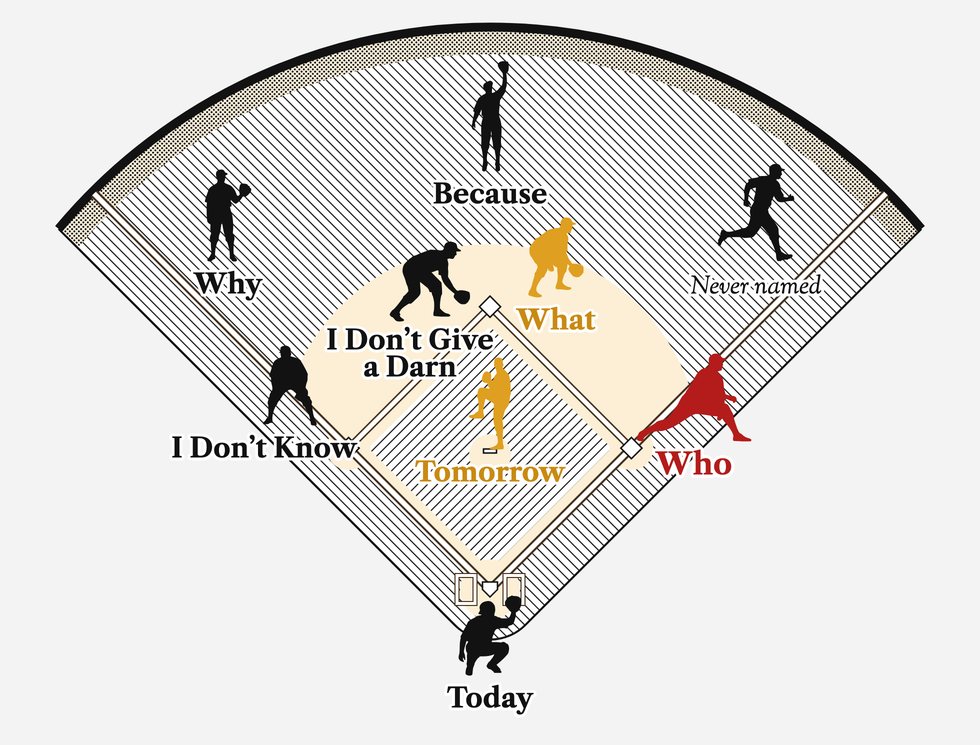
Hover over any player and you get the back of his baseball card. No picture, just his stats, counted from the broadcast: how many times Abbott says his name, how many times Costello does and his share of every name called. Who leads the club at .426. On a phone the cards sit in a row you can swipe.
The look
Why does it look like a 1930s radio bill?
Because that’s where the routine first lived.
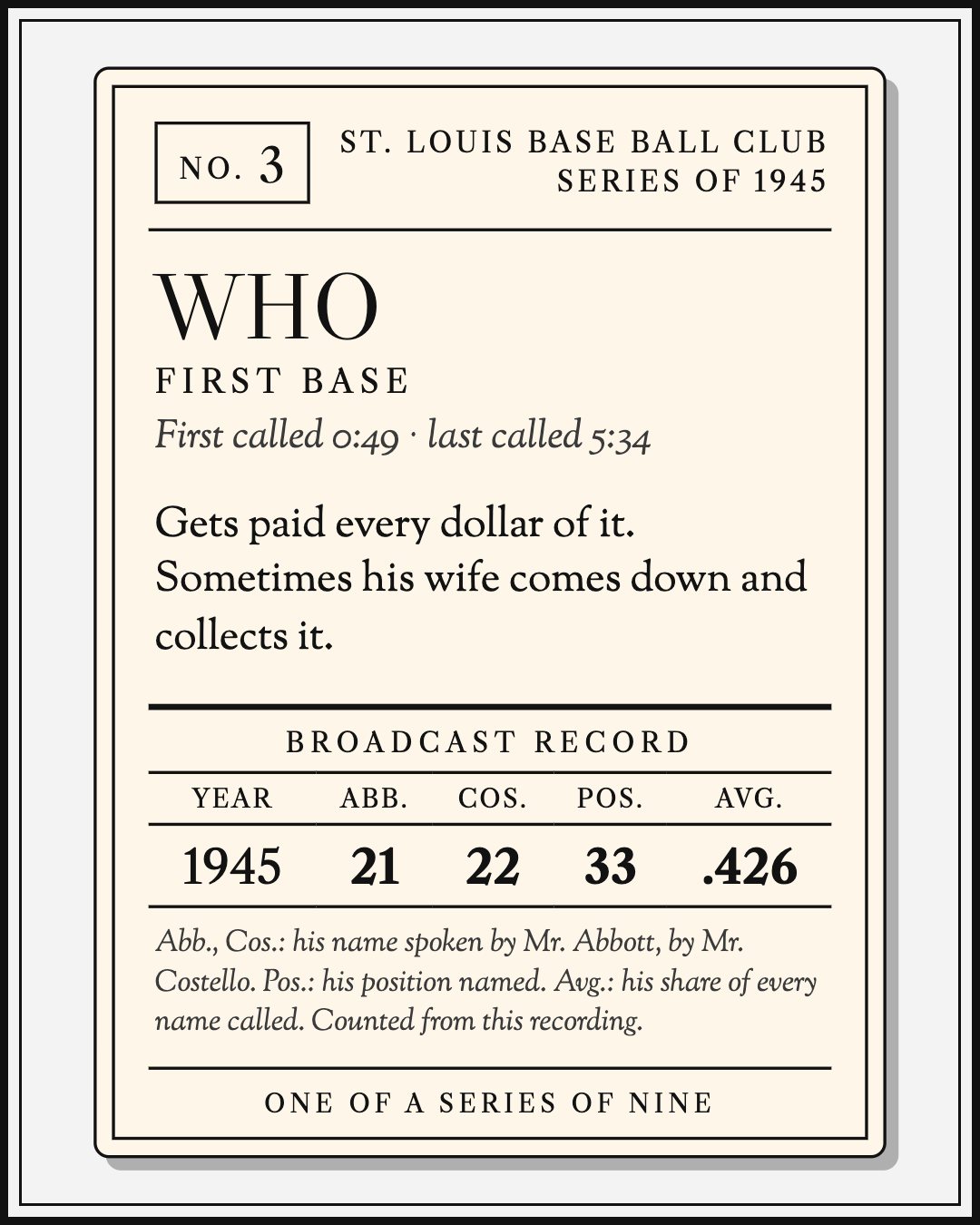
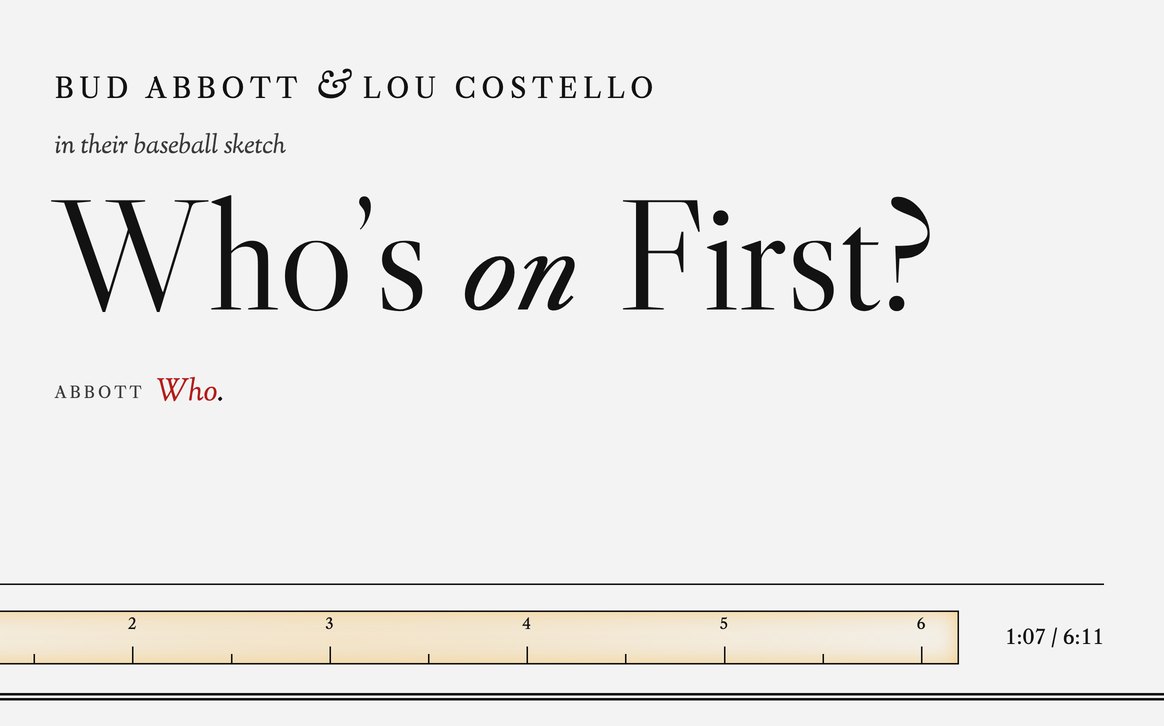
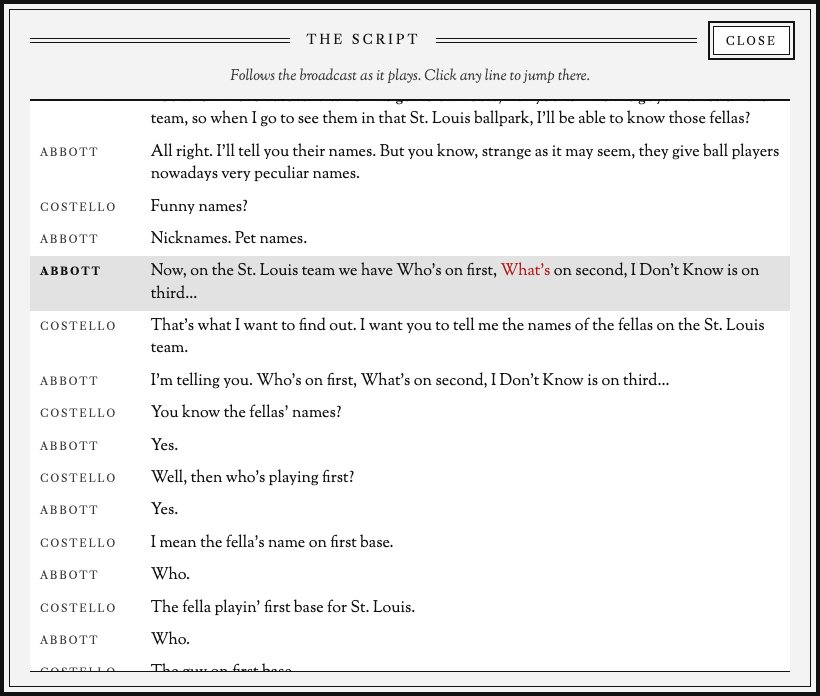
It was first heard nationally on The Kate Smith Hour in 1938, so I set the page like a program from that night: black and white, Caslon and Goudy type, a double-ruled frame and a pen-and-ink caricature. The only real colors are the red of the stitching on the baseball, which marks a player when his name is called, and a gold for when only his position is named. The title, the line on the air and the dial stay pinned at the top while you scroll, so the broadcast never stops, and the script and program notes wait in pop-ups, so nothing crowds the joke.
The sound
Where does the sound come from?
It’s a new performance of the routine as played in the 1945 film The Naughty Nineties, adapted for radio.
The cast was designed with AI voice tools from written descriptions, not cloned from Abbott and Costello, and then directed like a radio session: Costello’s voice drops when he thinks he understands, Abbott tightens in the last third, and the two nearly talk over each other. I cut the bat and the hat, because a sight gag doesn’t play on the air.
The process
How did it come together?
By working the questions.
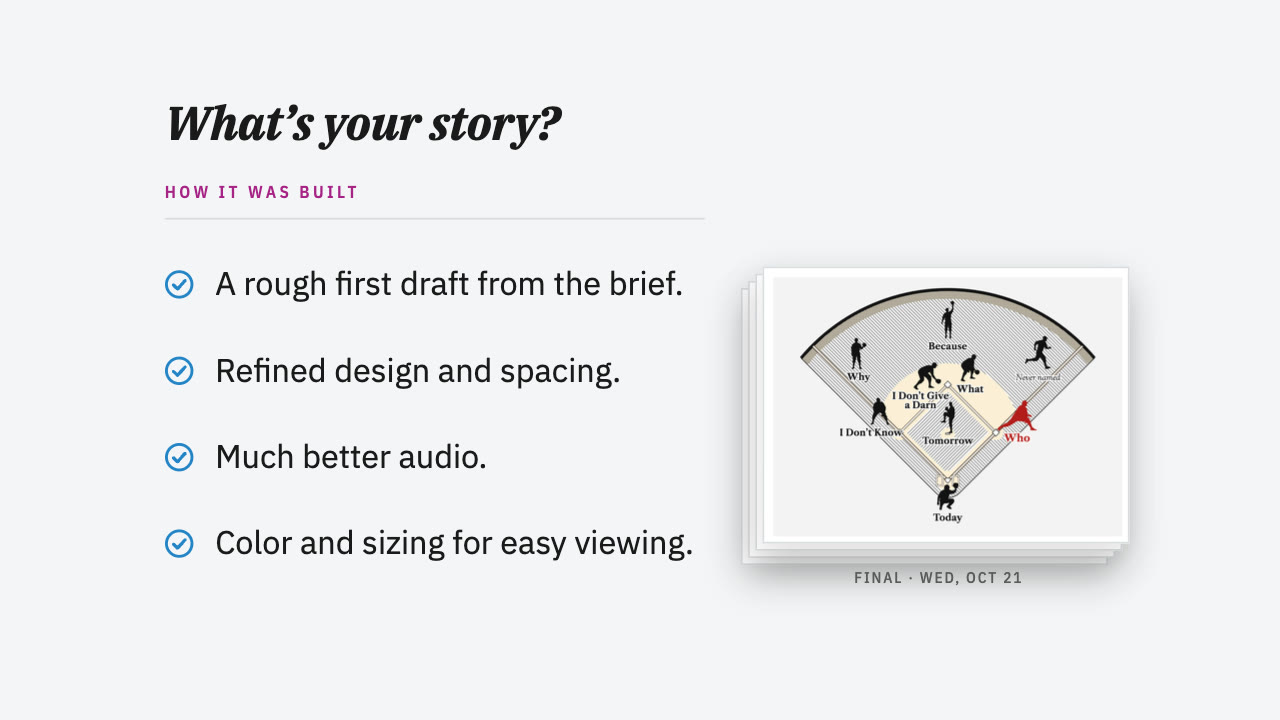
Can you see who’s on each base? Is every fact right? How do you make the timing land? How do you show a name being called? I placed every element, chose the fonts, set how the text highlights and picked the colors, and I put AI tools to work on the research, the voices and the code, pushing back until each answer was right: even out the players, lose the underlines, a name is not a position. Every date was checked against the Library of Congress, the Baseball Hall of Fame, Time and AFI.
Your story
What could this do for your story?
Almost everybody has a recording that matters to them.
An oral history, a founder’s speech, a radio spot, the call from a big game. Most of the time it sits behind a play button nobody presses. Give it a stage and people stay with it.
Where can you play it?
Play the whole broadcast, watch the line-up and flip through the cards.
What’s your story?
Let’s tell it.
How it was built
Role
- Concept
- Art direction
- Design
- Audio direction
- Custom-coded build
Scope
- One interactive page with a six-minute broadcast, a live ballfield, nine baseball cards, a follow-along script and program notes
- A short film of the story and the finished page
- A 29-second teaser in three formats
- This case study
Tools
AI tools for research, voice design, the studio audience, the caricature and player silhouettes, speech timing, the code and second-opinion reviews, all under my direction.
Notes
A proof of concept, not commissioned by or affiliated with HISTORY, Universal Pictures or the Abbott and Costello estates, presented for demonstration and educational purposes.
The voices are new, not Abbott and Costello.
Every fact on the page was checked against the Library of Congress, the Baseball Hall of Fame, Time and AFI.