
I’ve been keeping a secret from Adobe. I don’t think they’ll be too surprised.
Earlier this month a software engineer named Brandon Thomas and the team behind ArtCraft released free, open-source clones of Adobe’s biggest programs: Photoshop, Illustrator, InDesign, Premiere Pro, After Effects, Lightroom and Acrobat. They built them with AI. They run on Mac, Windows and Linux, and anybody can download them.
Are they finished? Nope, and they’ll tell you so themselves. The PhotoCraft page says it’s “not yet a Photoshop replacement for daily professional work.”
But I realized something pretty quickly. They don’t have to be perfect. Not a single one of them. You can drive every one of those programs with an AI, and when the AI runs into a flaw, it can either work around it or fix it.
So that’s the news. Now for my secret.
I built my own Adobe XD
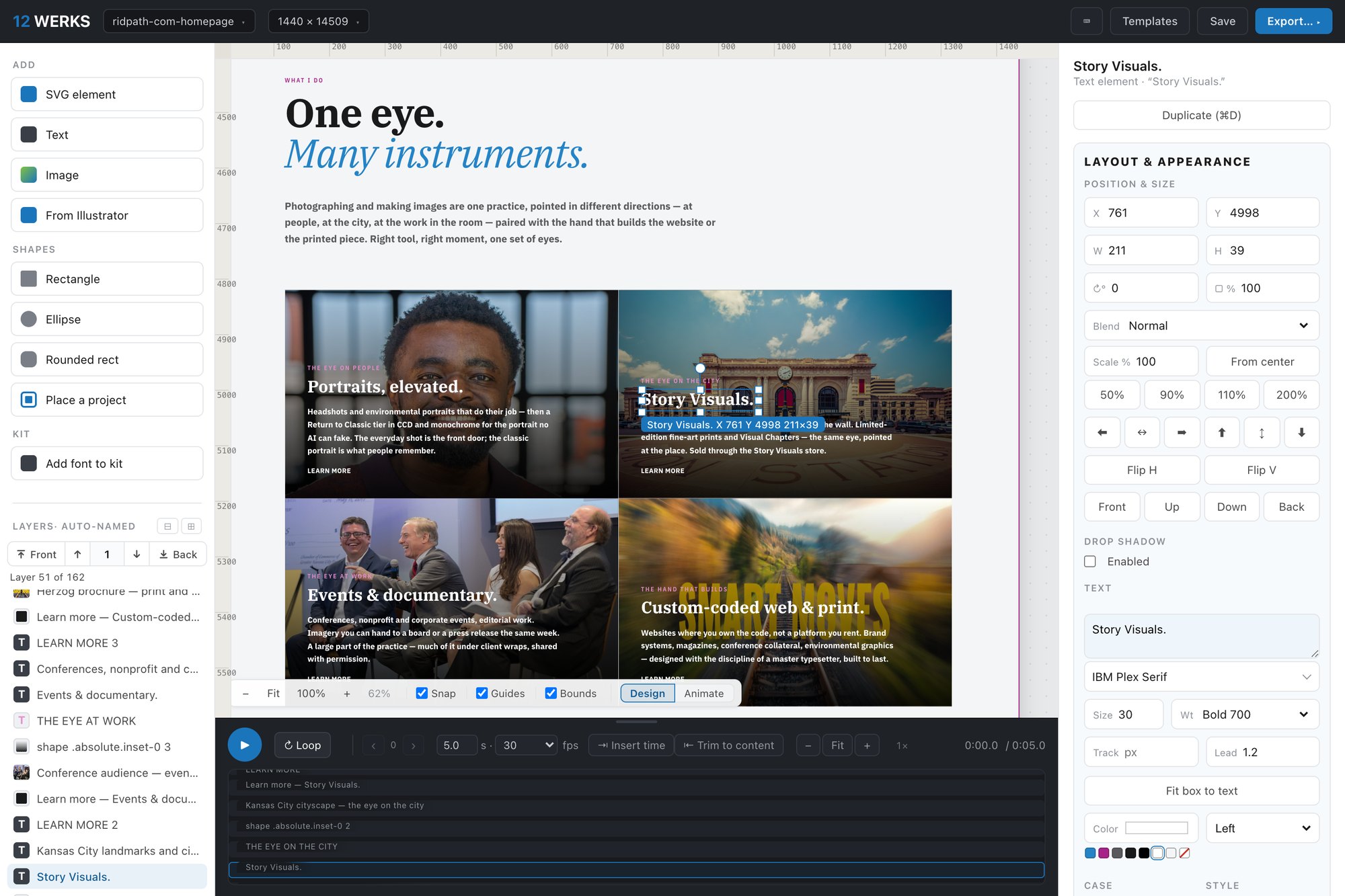
Back in June, I sat down and built my own replacement for Adobe XD. Some people call this vibe coding. I’d call it art direction. I’m not a programmer. I understand how code works from about 10,000 feet, and I’ve spent 35 years inside just about every design program there is. I know what I want a program to do. So I described it one piece at a time, the same way I’d direct a photo shoot, and the AI wrote the code.
Why XD? Because Adobe quit working on it, and it could have been so much more.
The first working version came together overnight. Four months later, I use it for real client work: business cards, animated ads, website layouts, social graphics. It has artboards in several sizes at once, layers and groups, and a motion timeline. It exports video, GIFs, layered SVG files and real Illustrator files. Paste in a web address and it pulls the page apart into pieces you can move around. Right-click a photo and it opens in Photoshop. (Yes, I still use Photoshop. This isn’t a breakup letter.)
Why is it called 12 WERKS?
I call it 12 WERKS. Say it “twelve works.”
The name comes from the twelve principles of animation, the rules Disney’s animators worked out starting in the 1930s. Frank Thomas and Ollie Johnston, two of Walt’s “Nine Old Men,” wrote them down in their 1981 book, The Illusion of Life. Squash and stretch. Anticipation. Timing. Appeal. Animators still learn them today. 12 WERKS does motion as well as layout, so it seemed right to borrow from the people who taught drawings how to move. (No relation to Brandon Thomas, as far as I know.)
Why don’t the clones have to be perfect?
For as long as I’ve been doing this, software had to be finished before it was useful. If Photoshop didn’t have the tool you needed, you waited for Adobe to ship it. Maybe next year. Maybe never. Ask anybody who used XD.
That’s over. When an AI is driving the program, a missing feature is a speed bump. There are three ways past it:
- The AI works around it. It gets you to the result another way, with the tools that are there.
- The AI fixes it. The code is open, so the problem can be patched.
- You fork it. A fork, in open-source terms, is your own branch of the project. Don’t like how something works? Make your own version and fix it.
I watched this happen this morning. I needed to set a logo onto a photo of a brass plaque, which takes a Multiply blend mode. 12 WERKS didn’t have one. Before lunch, it did.
It won’t always be that easy. A Photoshop clone is a much bigger animal than my little XD, and things like color management and print output are hard problems. But the PhotoCraft project already tells AI agents where to start if they want to help. Sounds to me like the people who built it are counting on exactly that.
And folks are already making copies. As of today, PhotoCraft has been forked on GitHub more than 10,000 times. Most of those copies will never get touched, I’m sure. But that’s still a lot of people who’d rather have their own version than wait on somebody else.
How did Adobe get here?
Let me set some dates next to each other.
On September 15, 2022, Adobe announced it would buy Figma, XD’s biggest competitor, for about $20 billion. Eleven weeks later, on November 30, OpenAI released ChatGPT.
That was the freight train.
Adobe spent the next fifteen months trying to get the Figma deal past regulators in Europe and the UK. In December 2023 they gave up, and Figma walked away with a $1 billion termination fee. By then XD had been in maintenance mode since May. Adobe told The Register it had pulled its investment in XD “years before” the Figma agreement. According to Adobe’s own general counsel, XD was bringing in no more than $15 to $17 million a year. And Adobe was willing to pay $20 billion for the other guy’s tool.
So they let their own program starve, then tried to buy a competitor to fill the hole. You could argue that was smart business: stop feeding the loser and buy the winner. Maybe so. But the bigger hole was sitting right in front of them the whole time. What could fifteen months and a billion dollars have built in AI? Probably a lot.
To be fair, Adobe hasn’t been asleep. Firefly, their image generator, arrived in March 2023, and last fall at Adobe MAX they showed AI assistants for Photoshop and Adobe Express. But an AI feature inside a program is a different thing from what just happened, which is AI rebuilding the program itself.
So what does this mean for Adobe?
I don’t know, and I don’t think anybody does yet.
I suppose there are big corporations and universities holding thousands, maybe tens of thousands, of Adobe licenses on multi-year agreements. That money isn’t going anywhere in the next year or two. IT departments don’t swap out software because of a Reddit post.
And I’ll give Adobe this: Creative Cloud is more than a pile of programs. It’s the file formats everybody trades, the fonts, the color management, the support line, the security reviews. That’s worth a lot, and it will buy them some time.
But only some. Adobe needs to do something, and they need to do it fast.
What should Adobe do?
My recommendation: either partner with one of the AI companies already out there, or build an AI that is completely focused on visual creation.
If anybody can clone the programs, then the programs aren’t what Adobe has to sell anymore. What’s left is knowing what good looks like.
Today’s AIs can make pictures. What none of them does very well yet is take the language of design, the thoughts and ideas about visuals and branding, what a client means when they say “make it feel more premium,” and hit the nail on the head. That’s a design problem as much as a technology problem. Adobe has more than forty years of design knowledge under its own roof. I can’t think of anybody better positioned to build that AI.
Adobe MAX is in Miami Beach November 10 to 12. If I were in that room, I’d want to hear about that AI, not another feature for a program somebody just cloned for free.
If Adobe wants to grab the bull by the horns, they’d better get started on that yesterday.
In the meantime, I’ve got a brass plaque to finish.
Sources
- Amateur Photographer, October 8, 2026: Brandon Thomas and the free Adobe clones
- XDA Developers, October 10, 2026: the seven Adobe programs, written in Rust
- ArtCraft apps: the free, open-source downloads for Mac, Windows and Linux
- PhotoCraft on GitHub: “not yet a Photoshop replacement for daily professional work,” its notes for AI agents, and the fork count
- The Register, January 31, 2024: Adobe XD in maintenance mode, its revenue, and “years before” the Figma deal
- Adobe newsroom, December 18, 2023: Adobe and Figma end the merger announced September 15, 2022
- The Register, December 18, 2023: the $1 billion termination fee
- ChatGPT: released November 30, 2022
- Adobe Firefly announcement, March 21, 2023: the Firefly beta
- Capture magazine on Adobe MAX 2025: AI assistants for Photoshop and Adobe Express
- Adobe MAX 2026: November 10 to 12, Miami Beach
- Twelve basic principles of animation: Frank Thomas and Ollie Johnston, The Illusion of Life, 1981
Published October 14, 2026. Part of the Ridpath Creative journal: notes on craft, typography, and the work.